Your freight plan can break fast when one war hits two chokepoints at once. That is exactly why logistics teams now need a clear view of where container rates could move next if the Iran conflict lasts beyond a short shock. As of March 8, 2026, the market does not show one single rate story. It shows three. Gulf-linked lanes have already jumped.
Asia-Europe and Asia-Mediterranean lanes still look contained, but they sit on top of fragile routing assumptions. Transpacific prices remain calmer, though that can change if carriers keep sending more ships around the Cape of Good Hope.
In practice, what actually works is separating immediate disruption from second-round disruption. Immediate disruption hits Gulf cargo, insurance, and bunker costs first. Second-round disruption shows up later in Europe and the U.S. when longer loops absorb capacity, blank sailings return, and schedules slip. This piece lays out the current numbers, the routes at greatest risk, and the most likely rate path if the war extends through the next several weeks.
The market has already split into three stories
Gulf cargo moved first
The clearest early signal came from the Middle East itself. Freightos reported that Shanghai to Jebel Ali rates jumped from about $1,800 per FEU on Saturday to more than $4,000 by Tuesday. Reuters also reported that Iranian attacks hit Jebel Ali, the region’s largest container port, suspending operations for hours. That matters because Jebel Ali works like a giant regional warehouse, feeding cargo onward across the Gulf, East Africa, and South Asia.
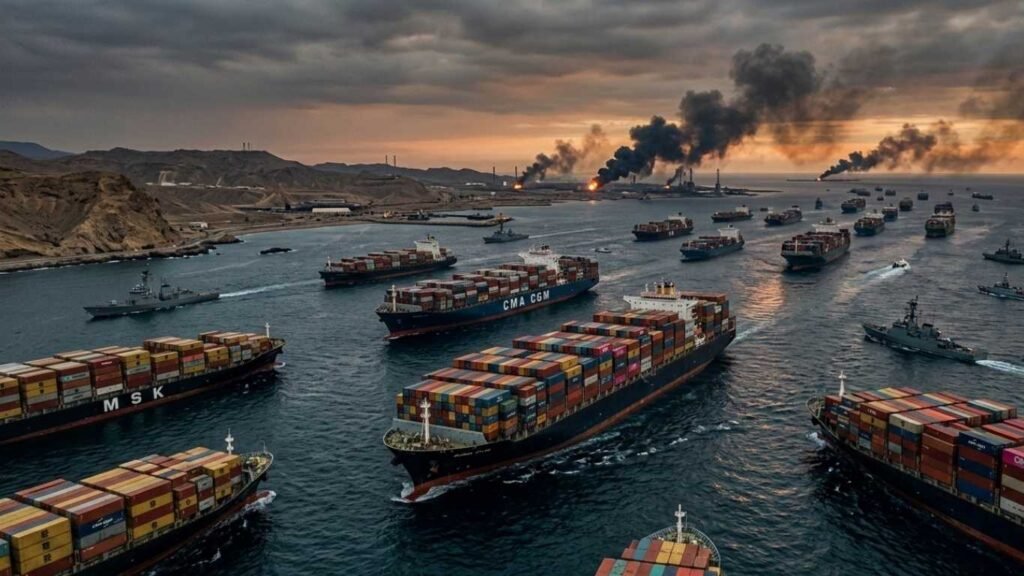
At the same time, Ocean Network Express CEO Jeremy Nixon said roughly 100 container ships, about 10% of the global container fleet, were caught in the Strait of Hormuz backup. When that much equipment stalls at once, the disruption does not stay local. Boxes miss repositioning windows, port rotations lose rhythm, and carriers protect margins with surcharges or tighter booking controls.
| Lane or benchmark | Latest level | Latest signal | What it tells you now |
|---|---|---|---|
| Global FBX | $1,637.40 per FEU | Broad market still below crisis peaks | Global pricing has room to rise if disruption spreads |
| China to North Europe, FBX11 | $2,614.20 per FEU | Still moderate | Europe has not fully priced in a longer war |
| China to Mediterranean, FBX13 | $3,717.00 per FEU | Higher exposure | Med lanes carry more direct Red Sea sensitivity |
| China to U.S. West Coast, FBX01 | $2,021.80 per FEU | Relatively calm | Transpac still reflects weaker structural pressure |
| China to U.S. East Coast, FBX03 | $2,748.40 per FEU | Moderate | Vulnerable if Cape diversions keep absorbing ships |
| Drewry WCI composite | $1,958 per 40ft | Up 3% week on week | Pressure has started, but not across all lanes |
| Shanghai to Jebel Ali | Above $4,000 per FEU | Sharp spike in days | Gulf disruption is already real, not theoretical |
Current benchmark data in the table comes from Freightos and Drewry, with the Jebel Ali spike from Freightos’ March 4 market update.
Europe and the U.S. have not fully repriced yet
Drewry’s March 5 data shows Shanghai-Rotterdam at $2,052 per 40ft and Shanghai-Genoa at $2,844, while Shanghai-Los Angeles rose to $2,402 and Shanghai-New York to $2,977. That mix matters. Europe lanes had not yet surged, but transpac rates were already ticking higher after Lunar New Year factory reopening. In other words, the market entered this shock with prices soft enough to absorb some disruption, but not enough to ignore a prolonged one.
From experience, that is how shipping shocks usually begin. The first few days look messy but local. Then schedules stretch, equipment goes missing, and a regional spike starts leaking into broader global pricing.
Why the war raises costs even in an oversupplied market
Fuel, insurance, and time all move together
Before this war shock, the big 2026 story was oversupply. Maersk said new vessels and a fuller return to the Red Sea would free 6% to 7% of global container capacity and put pressure on freight rates. That logic still matters. However, it only holds if ships can actually use the shorter route safely. Once carriers divert around Africa again, that spare capacity starts disappearing into longer voyage loops.
Goldman Sachs said on March 6 that average daily flows through the Strait of Hormuz were down 90% and warned Brent could move above $100 a barrel if no solution emerged quickly. Drewry also warned that higher bunker fuel costs, war-risk premiums, and operational disruption would place upward pressure on container shipping rates if the situation persists. Reuters separately reported that war-risk premiums had jumped and some insurers had scaled back or withdrawn coverage.
Think of it like closing a major motorway and forcing all trucks onto a longer ring road. You still own the same trucks, but you complete fewer trips each week. Shipping works the same way. A longer loop means each vessel delivers less annual capacity, even if headline fleet size does not change.
| Cost driver | What changed | Why it matters for container pricing |
|---|---|---|
| Bunker fuel | Oil shock risk rose sharply | Higher voyage cost feeds into surcharges and GRIs |
| War-risk insurance | Premiums jumped, coverage tightened | Gulf and Red Sea calls become more expensive |
| Transit time | Cape routing adds 10 to 14 days on key lanes | Effective vessel capacity shrinks |
| Booking behavior | Some carriers halted Gulf bookings or rerouted services | Capacity becomes less predictable |
| Equipment flow | Ships and boxes sit longer in wrong places | Repositioning costs rise |
The cost stack in this table reflects reporting from Reuters, APL Logistics, and Drewry.
Carriers have already started passing costs on
This is not just a futures-market scare. MSC has announced emergency fuel surcharges from Northern Europe, the Mediterranean, and the Black Sea to the Red Sea, East Africa, and the Indian subcontinent, with dry-container charges ranging from $30 to $75 per TEU depending on route. Those are still modest charges compared with a full-scale crisis spike, but they show the pricing mechanism is already active.
What actually works in analysis is watching the first surcharge notices, not waiting for the index headline. Surcharges often tell you where carriers think pain will spread before the weekly benchmarks fully react.
Which trade lanes move next
The order of impact matters
The first lanes to rise are the ones with direct Gulf exposure. That includes Asia to Jebel Ali, India-Gulf trades, Europe to Red Sea cargo, and any service touching UAE, Oman, Qatar, or adjacent feeder networks.
Reuters reported that major carriers including Maersk, Hapag-Lloyd, CMA CGM, and MSC diverted vessels away from the Suez Canal and Bab el-Mandeb after the conflict escalated, while some also paused bookings or added war-risk surcharges.
The second wave hits Asia-Europe and Asia-Mediterranean. APL Logistics says Cape of Good Hope diversions add 10 to 14 days to Asia-Europe and Asia-U.S. East Coast voyages. Drewry’s own March 5 note said Asia-Europe rates remained under pressure for the moment, but carriers had already begun capacity planning and expected rates to increase in the coming weeks. That is a useful clue. Europe lanes have not exploded yet, but the setup for higher pricing is already there.
A good real-world example is a retailer trying to restock Ramadan, summer, or back-to-school inventory into Gulf and Mediterranean markets. One missed hub call at Jebel Ali or one extra Cape loop can shift both delivery date and inland capacity planning. The ocean quote changes first, but your warehousing and trucking plan usually feels the hit a week or two later.
Transpacific will lag, not escape
The U.S. lanes should react later unless the crisis broadens or carriers reposition more ships away from east-west trades. Freightos’ current benchmarks still show China-U.S. West Coast at $2,021.80 and East Coast at $2,748.40, while Drewry put Shanghai-Los Angeles at $2,402 and Shanghai-New York at $2,977 on March 5. Those numbers are firm, but they are not panic numbers.
However, do not confuse lag with safety. If Cape routings persist, some Asia-U.S. East Coast services feel the squeeze because they compete for ships, boxes, and schedule buffers across a global network. That is why the Iran shock can raise rates in lanes that never go near Hormuz.
Forecast for the next 30 to 90 days
Three scenarios matter most
The base case is not a full normalization. It is a messy, high-risk market where Gulf rates stay elevated, Europe firms, and transpacific edges up. That view fits the current data best because the market entered 2026 with too many ships, yet the war has already trapped capacity and lifted fuel and insurance risk.
The bullish case for rates comes from a longer conflict plus wider Red Sea danger. Reuters reported that U.S. reinsurance support could cover losses up to $20 billion, but also noted that any return of Houthi attacks would leave two critical chokepoints under military threat at once. If that happens, the market stops acting like a regional Gulf disruption and starts acting like a global capacity shock.
| Scenario | Next 2 to 4 weeks | Next 1 to 3 months | Most exposed lanes |
|---|---|---|---|
| Short disruption, partial stabilization | Gulf premiums stay high, broad indices firm but contained | Rates ease back, oversupply returns as main story | Gulf imports, Red Sea feeders |
| Extended war, Hormuz friction continues | Gulf rates stay elevated, Europe and Med rise, East Coast follows | Sustained higher rate floor, more surcharges, weaker schedule reliability | Asia-Europe, Asia-Med, Gulf, U.S. East Coast |
| Two-chokepoint shock, Hormuz plus renewed Red Sea attacks | Fast spike in spot and emergency charges | Global rate rebound, more blank sailings, equipment dislocation | Nearly all east-west trades |
This forecast table combines current carrier actions, Drewry’s March 5 outlook, APL’s transit-time estimate, and Reuters reporting on fleet disruption, insurance, and energy risk.
From experience, the market often overshoots in the first news cycle, then finds a higher but more stable range. That is why I would not forecast a repeat of the pandemic peak from current data alone. I would forecast a clear upward reset if the war lasts, with Gulf lanes highest, Mediterranean next, North Europe after that, and transpacific trailing unless service withdrawals intensify.
What shippers should do now
Booking strategy that actually works
You do not need to panic-book every lane. You do need to separate critical Gulf cargo from everything else. For Gulf and Red Sea-linked moves, secure space early, expect surcharges, and build extra lead time into your inland plan. For Europe and the U.S., watch weekly indices and carrier notices closely, because the second-round price move will likely come from schedule erosion before it shows up as a headline spike.
In practice, the best hedge is optionality. Split volume between contract and spot where you can. Protect must-arrive cargo with earlier bookings, but avoid overcommitting on lanes where oversupply still caps upside. Give your team 10 to 14 extra days on exposed routings, and keep close tabs on feeder and transshipment points, especially around Jebel Ali and Mediterranean hubs.