If you have ever wondered what do logistics managers do, the short answer is simple: they keep goods moving, costs controlled, and service levels on track. They connect procurement, inventory, transportation, and warehouse execution so your operation runs without avoidable delays. This guide explains the role, the daily work, and the KPIs that matter most.
Takeaways
- They coordinate flow: They align purchasing, transport, warehousing, and inventory to keep product moving.
- They protect performance: They balance cost, service, speed, and compliance while solving disruptions fast.
- They lead execution: They work across operations, suppliers, carriers, and customer teams to hit delivery targets.
What Do Logistics Managers Do in Modern Supply Chains?
At a high level, logistics managers plan, direct, and improve how products move and where they sit between origin and customer demand. CSCMP defines logistics management as the function that plans, implements, and controls the efficient flow and storage of goods and related information. The U.S. Bureau of Labor Statistics puts the manager side of the role this way: they “plan, direct, or coordinate transportation, storage, or distribution activities.”
That usually covers:
- Transportation planning
- Inventory control
- Warehouse operations
- Order fulfillment
- Process improvement
They do not just move boxes. They manage flow, capacity, risk, and service trade-offs so your network performs under pressure.
7 Core Responsibilities That Define the Role
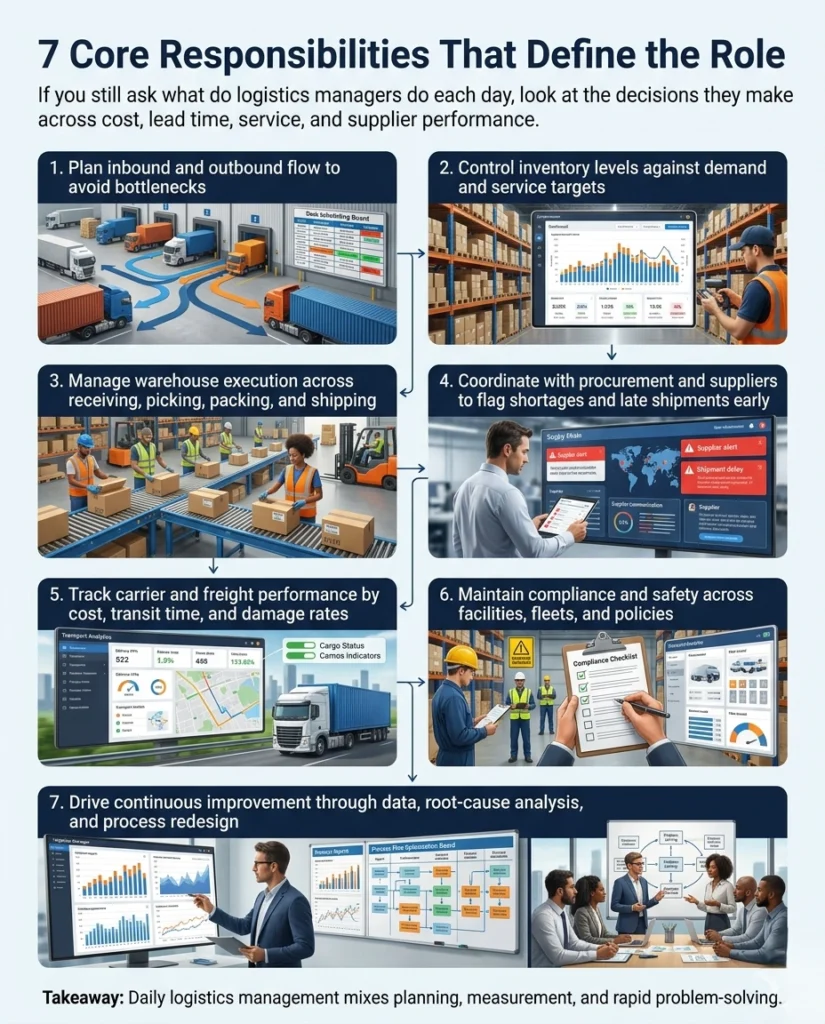
If you still ask what do logistics managers do each day, look at the decisions they make across cost, lead time, service, and supplier performance.
- Plan inbound and outbound flow to avoid bottlenecks.
- Control inventory levels against demand and service targets.
- Manage warehouse execution across receiving, picking, packing, and shipping.
- Coordinate with procurement and suppliers to flag shortages and late shipments early. [Internal link: procurement and logistics coordination]
- Track carrier and freight performance by cost, transit time, and damage rates.
- Maintain compliance and safety across facilities, fleets, and policies.
- Drive continuous improvement through data, root-cause analysis, and process redesign.
Takeaway: Daily logistics management mixes planning, measurement, and rapid problem-solving.
How Logistics Managers Create Value
Strong logistics managers protect more than delivery dates. They improve working capital, support vendor management, and give teams better visibility into lead time, capacity, and customer commitments. Therefore, when this role performs well, procurement buys smarter, operations plans better, and sales promises more confidently.
You usually see the biggest gains in three places:
- Lower logistics cost
- Better service performance
- Fewer disruptions
The best managers also connect logistics data with purchasing, order management, finance, and customer service instead of working in a silo.
Takeaway: Great logistics management improves cost, service, and cross-functional coordination at the same time.
Skills, KPIs, and Tools That Matter Most
To perform well, you need analytical thinking, operational judgment, stakeholder communication, and execution discipline. You also need the habit of acting before small issues become service failures.
Track these KPIs first:
- On-time delivery
- Inventory accuracy
- Order cycle time
- Freight cost per unit
- Warehouse throughput
- Fill rate
Most logistics managers rely on transportation systems, warehouse systems, ERP data, and dashboards to plan and track movement. BLS notes that logisticians use software systems to plan and track product movement and manage procurement-related data.
Takeaway: The best managers combine data, judgment, and fast execution.
FAQs
What do logistics managers do daily?
They monitor shipments, inventory, warehouse activity, supplier flow, and service exceptions. Then they adjust plans to protect cost and delivery performance.
What is the difference between a logistics manager and a supply chain manager?
A logistics manager focuses on movement, storage, and execution. A supply chain manager often owns a broader scope that includes sourcing, planning, and network strategy.
Do logistics managers work closely with procurement?
Yes. They share supplier timing, freight constraints, and inventory risk so purchasing decisions match operational reality.
Takeaway: The role stays valuable because it connects daily execution with broader supply chain performance.
Conclusion
So, what do logistics managers do when you strip the role to its essentials? They turn supply chain intent into operational results. They align transport, inventory, warehousing, and cross-functional coordination so customers get the right product at the right time with fewer surprises. If you want stronger logistics performance, start by tightening the processes, KPIs, and team handoffs that shape execution every day.