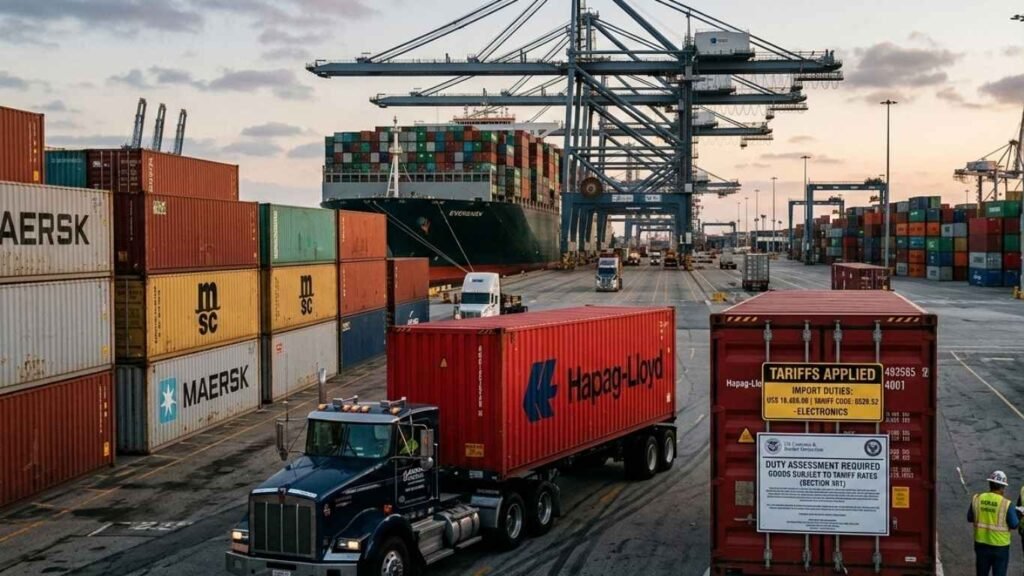
Washington, April 27, 2026: U.S. importers are facing a new tariff reality in which the pressure is no longer limited to duty rates at the border. Refund timing, carrier pass-through rules, administrative fees and supplier exposure are now shaping how companies plan procurement, pricing and supply-chain diversification.
The most immediate concern is cash flow. UPS says its tariff refunds process applies to certain 2025 tariffs collected under the International Emergency Economic Powers Act that were invalidated by the Supreme Court, with CBP launching the CAPE platform on April 20, 2026 for Importers of Record to submit refund requests. UPS also says CBP is expected to take at least 60 to 90 days to deliver refunds to Importers of Record, and UPS cannot issue refunds to payors until it receives the funds from CBP.
That delay creates a working-capital problem for companies that already paid duties, freight charges and customs-related costs. The issue is especially complicated when the business that paid the shipment bill is not the Importer of Record listed on the customs entry. In those cases, finance and logistics teams must confirm who controls the refund claim, which entries are eligible and whether the charge was a government duty or a carrier service fee.
| Pressure point | What companies need to manage |
|---|---|
| CBP refund timing | Refund recovery may take 60 to 90 days or longer |
| Carrier pass-throughs | Customers may wait until carriers receive CBP funds |
| Non-refundable costs | Administrative, brokerage or disbursement fees may remain |
| Medtech exposure | Supplier moves require compliance, validation and quality review |
| CPG exposure | Input costs can pressure shelf pricing and margins |
| Diversification | Companies need backup suppliers, SKU-level cost models and country-risk mapping |
Medtech companies are among the hardest hit because they cannot move suppliers as quickly as less regulated industries. KPMG’s healthcare exposure analysis says an estimated 62% of medical devices in the U.S. come from other countries, and nearly 70% of available U.S.-marketed devices are manufactured solely outside the U.S. That level of dependency makes tariff swings more than a purchasing issue. Medical-device companies must also consider product validation, FDA-related quality systems, supplier audits and continuity of patient-critical products.
Healthcare executives are not standing still. KPMG reported that 39% of healthcare respondents were reconfiguring supply chains, 39% were increasing investment in domestic markets and 39% were lobbying for government support. Those responses show why medtech diversification is likely to be gradual rather than sudden. Shifting production may reduce tariff exposure, but it can also raise labor, capital and compliance costs.
Consumer packaged goods companies face a different but equally urgent problem. KPMG’s CPG tariff strain findings show that 43% of surveyed consumer-goods executives reported a 1% to 5% decline in gross margins, while 77% said they had passed up to 50% of tariff costs to consumers. The same research found that 57% planned further price increases, a risky move in categories where shoppers can quickly switch to private-label or lower-priced alternatives.
Packaging is one of the clearest pressure points for CPG brands. Higher duties on metals can raise costs for cans, foil and other metal-packaged goods, while imported ingredients and raw materials can squeeze margins before products even reach retailers. For companies already negotiating promotions, shelf placement and retailer margins, tariffs can quickly become a commercial issue rather than a back-office trade matter.
BCG’s tariff planning note warned: “Scenario-based planning is critical to being ready to act.”
The practical response is moving from short-term refund recovery to long-term resilience. Companies are building landed-cost models by SKU, separating refundable duties from non-refundable charges, reviewing supplier contracts, qualifying secondary suppliers and mapping where tier-2 and tier-3 vendors depend on a single country.
The broader lesson is clear: tariff refunds may return some cash, but they do not remove the structural risk. For medtech and CPG firms, the stronger position is to treat tariffs as a supply-chain design problem, not just a customs recovery exercise.