
CBM Calculator
Enter carton dimensions in any unit. Returns volume, chargeable weight, container fit and an indicative freight range.
| Length | Width | Height | Qty | Kg / unit |
|---|
Volumetric weight by mode
| Mode | Divisor | Volumetric weight | Billed on |
|---|
Container fit
| Container | Nominal CBM | Practical 85% | Your fill | Cartons |
|---|
Indicative LCL ocean freight
CBM (cubic metre) is the standard volume unit in international freight. Calculate it by multiplying length × width × height in metres. From centimetres, divide the result by 1,000,000. Your freight cost is based on chargeable weight, which is whichever is greater: your CBM or your gross weight in tonnes.
The CBM Calculator above returns more than a volume figure, because volume alone is not the number you are actually looking for. You want to know what the shipment will cost, whether the quote you received is reasonable, and why the forwarder’s measurement came back higher than yours. This page covers all three.
What is CBM in shipping?
CBM stands for cubic metre, written as m³. It is the volume of a cube measuring one metre on each side, equal to 1,000,000 cubic centimetres or approximately 35.31 cubic feet.
In freight, you are not buying weight capacity. You are buying space. A container has a fixed internal volume, and carriers sell that volume. CBM is how they measure what portion of it you occupy. It appears on packing lists, booking confirmations, bills of lading, air waybills and every LCL quotation you will receive.
The CBM formula
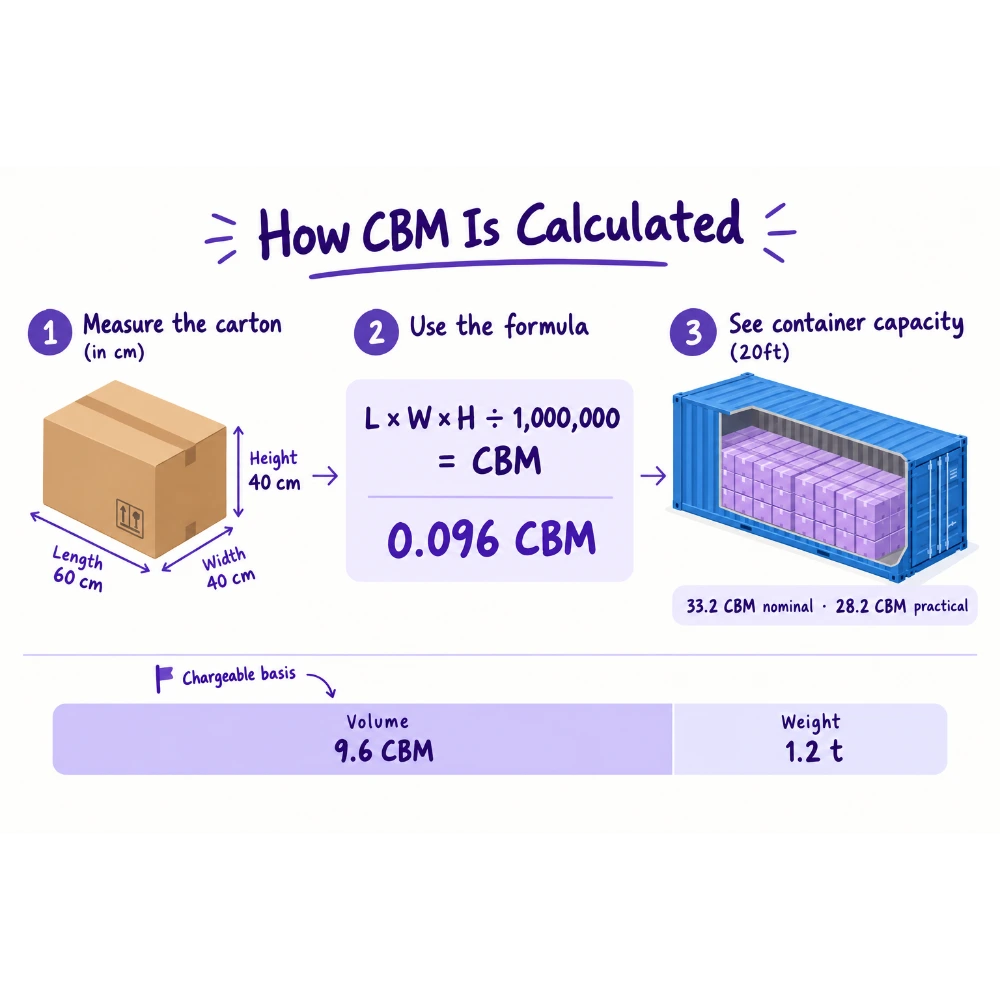
All three dimensions must be in the same unit before you multiply. This single rule accounts for most calculation errors in freight.
| Your measurement unit | Formula | Divisor |
|---|---|---|
| Metres | L × W × H | none |
| Centimetres | (L × W × H) ÷ 1,000,000 | 1,000,000 |
| Millimetres | (L × W × H) ÷ 1,000,000,000 | 1,000,000,000 |
| Inches | (L × W × H) ÷ 61,023.7 | 61,023.7 |
| Feet | (L × W × H) ÷ 35.3147 | 35.3147 |
How do you calculate CBM in cm?
Multiply the three dimensions in centimetres, then divide by 1,000,000. Centimetres are the most common unit on supplier packing lists, which is why this is the version most importers need.
A carton measuring 60 cm × 40 cm × 40 cm gives 96,000 cm³. Divided by 1,000,000, that is 0.096 CBM per carton. This is close to a standard export carton size, so it is a useful reference point: roughly ten of these make one cubic metre.
How do you calculate CBM in mm?
Multiply the three dimensions in millimetres, then divide by 1,000,000,000. A carton of 600 mm × 400 mm × 500 mm is 120,000,000 mm³, which is 0.12 CBM.
Millimetres are common on engineering drawings and on packing lists from Chinese and German suppliers. Treating those figures as centimetres is the single most expensive unit error in freight, and it is covered in detail further down this page.
How do you calculate CBM in inches?
Multiply the three dimensions in inches, then divide by 61,023.7. A carton of 24 in × 16 in × 16 in is 6,144 in³, which is 0.1007 CBM.
The divisor comes from the fact that one cubic metre contains 61,023.74 cubic inches. If you prefer to convert first, multiply each inch measurement by 0.0254 to get metres, then multiply the three results together.
How do you calculate CBM in feet?
Multiply the three dimensions in feet, then divide by 35.3147. A crate of 4 ft × 3 ft × 3 ft is 36 ft³, which is 1.0194 CBM.
Cubic feet still appear on some North American domestic quotations, particularly LTL. To convert in the other direction, multiply CBM by 35.3147.
How do you calculate CBM for multiple boxes of different sizes?
Calculate the CBM of each carton size separately, multiply each by its quantity, then add the results. Do not average the dimensions across different carton types, which produces a materially wrong total.
| Carton type | Dimensions (cm) | CBM each | Qty | Line total |
|---|---|---|---|---|
| A | 60 × 40 × 40 | 0.096 | 120 | 11.52 |
| B | 50 × 30 × 30 | 0.045 | 80 | 3.60 |
| C | 80 × 60 × 50 | 0.240 | 15 | 3.60 |
| Total | 215 | 18.72 CBM |
The CBM calc tool above handles this with the add carton size button. At 18.72 CBM this shipment sits above the point where a 20ft full container should be priced alongside LCL, which is explained below.
What is chargeable weight, and how is it different from CBM?
CBM measures volume. Chargeable weight is the figure the carrier actually bills you on, and it is whichever is greater: your actual gross weight or your volume converted into a weight equivalent. Carriers apply this because a container fills up on space long before it fills up on weight for light cargo, and on weight before space for dense cargo.
| Metric | What it measures | Role in your invoice |
|---|---|---|
| CBM | Volume in cubic metres | The space you occupy |
| Gross weight | Mass including packaging | Compared against volume |
| Volumetric weight | Volume expressed as weight | Prices light, bulky cargo |
| Chargeable weight | The greater of the two | What you are billed on |
What does W/M mean on a freight quote?
W/M stands for weight or measurement. It means the carrier will bill on whichever produces the higher charge. In ocean LCL, one cubic metre is compared against one metric tonne, and the resulting unit is called a revenue ton.
A pallet measuring 1.2 m × 1.2 m × 1.5 m is 2.16 CBM. If it weighs 550 kg, volume wins and you are billed on 2.16 units. A crate of 1.8 m × 1.2 m × 1.2 m is 2.59 CBM, but if it weighs 2,900 kg the weight wins and you are billed on 2.9 units. Same rate card, different basis, and the difference is invisible until the invoice arrives.
This is the mechanism behind most LCL billing surprises. Importers calculate volume, receive an invoice based on weight, and assume an error has been made. Under W/M terms, no error has been made.
Which divisor applies, 5,000 or 6,000?
It depends on the mode, and getting it wrong changes your chargeable weight by 20 percent. Several widely used CBM calculators publish 5,000 as the air freight standard. It is not. 5,000 is the express courier divisor.
| Mode | Divisor | 1 CBM equals | Typical use |
|---|---|---|---|
| Ocean LCL | W/M | 1,000 kg (1 tonne) | Sea freight consolidation |
| Air freight (IATA) | 6,000 | 166.67 kg | Airline and forwarder air cargo |
| Express courier | 5,000 | 200 kg | DHL, FedEx, UPS international parcel |
The air freight figure of 166.67 kg per CBM is simply 1,000,000 cm³ divided by 6,000. The commonly quoted 167 kg is that number rounded. If a calculator returns 200 kg per CBM and calls it air freight, it has applied the courier divisor.
Always confirm the divisor in writing with your carrier before booking. Some forwarders apply 6,000 to consolidated air cargo and 5,000 to door-to-door services on the same rate sheet.
How many CBM are in a shipping container?
A 20ft standard container holds approximately 33.2 CBM, a 40ft standard holds 67.7 CBM, and a 40ft High Cube holds 76.3 CBM. These are nominal internal volumes. Realistic loading is 85 percent of those figures.
| Container | Internal dimensions | Nominal CBM | Practical at 85% | Max payload |
|---|---|---|---|---|
| 20ft GP | 5.90 × 2.35 × 2.39 m | 33.2 | 28.2 | ~21,700 kg |
| 40ft GP | 12.03 × 2.35 × 2.39 m | 67.7 | 57.5 | ~26,700 kg |
| 40ft HC | 12.03 × 2.35 × 2.69 m | 76.3 | 64.9 | ~26,460 kg |
| 45ft HC | 13.56 × 2.35 × 2.69 m | 86.0 | 73.1 | ~27,600 kg |
As a working rule, a 20ft container takes 10 to 11 Euro pallets on a single floor level and a 40ft takes 20 to 22, before any double stacking.
Why do different websites give different container capacities?
Because three different things get published under the same label, and most sources do not say which one they are quoting.
Search for the capacity of a 40ft High Cube and you will find 72, 76 and 76.3 CBM. For a 20ft you will find 31, 33 and 33.2. None of these is necessarily wrong. They are answers to different questions.
- Internal dimensions vary by manufacturer and build year. A few centimetres of internal height across 12 metres of length changes the total by more than a full cubic metre.
- Some sources quote nominal volume, others quote usable volume. Nominal is length × width × height. Usable subtracts the space lost to loading access, dunnage and irregular cargo shapes.
- ISO 668 standardises external dimensions, not the internal cube. The standard fixes the outside so containers stack and lock globally. Internal volume depends on wall and floor construction, which differs between builders.
For planning, use nominal figures to check whether cargo could theoretically fit, and practical figures to decide what to book. Equipment availability and container rate direction also affect whether a full container is worth booking. For contractual commitments, ask your carrier for the specific internal dimensions of the container type being supplied.
Why is my forwarder’s CBM higher than my calculation?
Four causes account for almost every discrepancy between a shipper’s CBM and the figure the forwarder bills on. All four are legitimate, and all four are avoidable if you know to ask about them before booking.
1. The forwarder measured the pallet, not the cartons
Once cartons are stacked on a pallet, the chargeable footprint becomes the pallet footprint and the total stacked height, including the pallet base. A standard pallet adds roughly 15 cm of height before a single carton is loaded, and the overhang or shortfall of cartons against the pallet edge is not deducted. If you calculated loose carton volume and the cargo shipped palletised, your figure will always be lower.
2. Strapping, wrapping and corner protection were added
Cargo is measured at the container freight station after it has been secured for export. Stretch wrap, edge boards, corner protectors and strapping all add to the measured envelope. On a tall pallet this can add several centimetres in each direction.
3. A different divisor was applied
If you calculated air freight volumetric weight at 6,000 and the warehouse applied 5,000, your chargeable weight rises by 20 percent with no change to the cargo. Confirm the divisor on the rate sheet, not in conversation.
4. Pallet tare weight was included at consolidation
A wooden pallet weighs 20 to 25 kg. If your packing list declared carton weight only and the forwarder weighed the palletised unit, gross weight rises. On a dense shipment already billing on weight rather than volume, this flows straight into the invoice.
How to prevent all four: state in the purchase order that the supplier must provide dimensions and gross weight of the sealed, export-ready unit as it will be presented to the forwarder, specify whether pallets are included, and require the divisor in writing on the quotation.
The millimetre and centimetre trap
If a supplier sends dimensions as 600 × 400 × 500 without a unit, they almost certainly mean millimetres. Read as centimetres, the error is a factor of 1,000.
| Reading | Calculation | Result |
|---|---|---|
| As millimetres (correct) | 0.6 × 0.4 × 0.5 | 0.12 CBM |
| As centimetres (wrong) | 6 × 4 × 5 | 120 CBM |
A carton dimension above roughly 300 cm on any side is a strong signal that the figures are millimetres. The calculator on this page flags it automatically. The sanity check to apply manually: a carton you would not be able to lift is probably not a carton.
Carton dimensions or product dimensions?
Always carton. Freight is priced on the outer shipping carton as presented to the carrier, not the product inside it. The carton includes inner boxes, void fill, desiccant, manuals and the corrugated wall itself.
The gap is routinely 15 to 30 percent. Calculating from a product spec sheet will always understate your shipment, and the difference appears at the freight station when it is too late to change anything.
A related discipline: confirm carton dimensions with the supplier in writing before production. A variance of 2 to 3 cm per carton, multiplied across several hundred cartons, moves your total CBM enough to change which container you should book.
What is the minimum CBM charge for LCL?
Most forwarders apply a minimum of 1 CBM or 1 tonne, whichever is greater. If your shipment is 0.4 CBM, you will still be invoiced for 1.
The practical consequence is that shipments between roughly 0.3 and 0.9 CBM carry a poor cost per unit. If you are close to the threshold, adding stock to reach a full cubic metre often costs nothing extra in freight. Below about 0.3 CBM, compare LCL against express courier, where the pricing basis is different and small consignments are not penalised in the same way.
At what CBM does FCL become cheaper than LCL?
The commonly cited break-even sits between 12 and 17 CBM, but the headline freight rate is not what decides it. Destination charges are.
LCL charges accumulate per cubic metre at both ends. Origin and destination CFS handling, terminal handling and deconsolidation all scale with your volume. FCL charges are largely flat per container. As your CBM rises, the per-unit LCL charges keep climbing while the FCL total does not.
The trap is booking LCL at 15 or more CBM because the per-CBM ocean rate looks competitive, then absorbing deconsolidation fees that exceed the entire flat FCL rate. Above roughly 12 CBM, ask for both quotes on a total landed basis, including every destination charge, before deciding.
One further option is a loose load: booking a full container but shipping less than a full load. You pay the container rate, but your cargo travels alone, which removes the consolidation handling and the damage exposure that comes with shared containers.
What does LCL actually cost per CBM?
Ocean freight is one line out of nine or more. A quotation showing only the per-CBM ocean rate is not a quotation, and the final invoice commonly lands 50 to 80 percent above it. Base rates also move with market conditions, as our reporting on ocean freight rate surges illustrates.
| Charge | Typical range (2026) | Basis |
|---|---|---|
| Ocean freight | USD 40 to 180 | per CBM |
| Origin CFS and handling | USD 35 to 75 | per shipment or CBM |
| Destination CFS and deconsolidation | USD 45 to 95 | per shipment or CBM |
| Terminal handling, both ends | USD 15 to 35 | per CBM |
| Bunker adjustment factor (BAF) | 5 to 12 percent | of base freight |
| Currency adjustment factor (CAF) | 0 to 5 percent | of base freight |
| Documentation and bill of lading | USD 35 to 75 | per shipment |
| ISF filing (US imports) | USD 35 to 50 | per shipment |
| Demurrage, if free time is exceeded | USD 5 to 15 | per CBM per day |
As a sense check, a 2 CBM shipment from China to Los Angeles commonly bills 400 to 750 USD all in. For a 4 CBM shipment, destination charges of 400 to 700 USD are within normal range. Materially above that warrants an itemised explanation.
Ask for free time at the destination CFS in writing. Three days is common, and demurrage at 5 to 15 USD per CBM per day accumulates quickly if customs clearance runs long.
How do you calculate CBM for cylindrical or irregular cargo?
For freight pricing, measure the smallest rectangular box the item would fit inside. In a container the item occupies that full rectangular envelope regardless of its actual shape, and that is what the carrier charges for.
Use the true geometric volume only when you need it for material or capacity purposes rather than freight:
- Cylinder: π × radius² × height
- Sphere: (4 ÷ 3) × π × radius³
- Freight envelope for either: maximum length × maximum width × maximum height
A drum of 0.6 m diameter and 0.9 m height has a true volume of 0.254 CBM but a chargeable envelope of 0.6 × 0.6 × 0.9, which is 0.324 CBM. You pay for the corners.
Should pallet weight be included on the packing list?
Yes, if the goods ship palletised. The forwarder and the carrier will weigh the palletised unit, so a packing list that excludes pallet tare creates a discrepancy between declared and actual weight at the freight station.
Specify the treatment in the purchase order. State that gross weight must include product, inner packaging, outer carton, strapping and pallet. That single line removes the most common source of weight disputes and gives you a documented reference point if the invoice disagrees.
CBM planning for Amazon FBA shipments
FBA introduces a constraint that pulls against freight efficiency. Amazon caps sortable cartons at 25 inches (64 cm) on any side and 50 lb (23 kg) for floor-loaded sortable product. Freight efficiency favours larger cartons. These requirements have to be reconciled before the supplier packs, not after.
A typical FBA carton of 50 × 40 × 30 cm is 0.06 CBM. That gives a useful planning scale:
| Cartons | Total CBM | Recommended mode |
|---|---|---|
| 50 | 3.0 | LCL |
| 200 | 12.0 | LCL, but price FCL alongside |
| 350 | 21.0 | 20ft FCL likely cheaper |
| 500 | 30.0 | 20ft FCL, approaching practical limit |
If you are loading a container direct to an Amazon fulfilment centre, allow 8 inches (21 cm) of clearance between the final carton row and the container doors. Amazon requires it for dock handling, and it reduces your usable depth.
Reefer and specialised containers
Refrigerated containers have less internal space than their dry equivalents because the refrigeration unit, insulated walls and airflow clearance all consume volume. Applying standard dry container capacity to a reefer booking overestimates carton count by roughly 12 to 15 percent.
Reefers also require air circulation gaps around and above the cargo, so the practical loading percentage is lower again. If you are shipping temperature-controlled cargo, request the exact internal dimensions and the maximum stacking height from the carrier before planning your load.
If you believe you have been overcharged
Start by requesting the measurement record from the CFS. A legitimate charge is supported by a dated measurement of the cargo as presented, and any reputable forwarder will produce it.
For United States imports, freight overcharge claims can be filed with the Federal Maritime Commission within three years of the date the cause of action occurred. Carriers are generally required to acknowledge written claims for adjustment within 20 days. Keep the quotation, the packing list, the bill of lading and the invoice together, because a claim without the original quotation is difficult to support.
Reviewing your wider freight spend at the same time is worthwhile, and our guide to reducing transportation cost in logistics covers the structural levers. Most disputes are resolved before that stage. The measurement record usually reveals which of the four causes above applied, and the conversation moves from a dispute to a process fix for the next shipment.
How this calculator works
Every figure this Calculator CBM tool returns is derived from the inputs below. Nothing is estimated behind the scenes.
- Unit conversion: mm ÷ 1,000; cm ÷ 100; inches × 0.0254; feet × 0.3048. Dimensions are converted to metres before multiplication, not after.
- Volume: length × width × height per carton, multiplied by quantity, summed across all rows.
- Cubic feet: CBM × 35.3147.
- Sea volumetric weight: CBM × 1,000 kg, the standard W/M revenue ton comparison.
- Air volumetric weight: cm³ ÷ 6,000, the IATA air cargo divisor, equal to 166.67 kg per CBM.
- Express volumetric weight: cm³ ÷ 5,000, the divisor commonly applied by international parcel carriers.
- Chargeable basis: gross weight compared against the volumetric equivalent; the greater is highlighted.
- Container capacity: nominal volumes of 33.2, 67.7, 76.3 and 86.0 CBM, with practical capacity shown at 85 percent to allow for loading access, dunnage and cargo shape.
- Freight range: chargeable units × 40 to 180 USD per CBM, the observed 2026 LCL ocean freight band. A 1 CBM minimum is applied. Destination charges are excluded.
Container internal dimensions vary between manufacturers and build years. ISO 668 standardises external dimensions so that containers stack and lock worldwide; it does not fix the internal cube. Treat the figures here as planning values and confirm the specific container with your carrier before contractual commitments.
Results are estimates for planning purposes. Verify chargeable weight and applicable surcharges with your carrier or freight forwarder before booking.
Frequently asked questions
Is CBM the same as m³?
Yes. CBM is the freight industry abbreviation for cubic metre. You will also see it written as cbm, CBM, m3 or cubic meter depending on region and house style. They all refer to the same unit.
How do I convert CBM to cubic feet?
Multiply CBM by 35.3147. To convert in the other direction, divide cubic feet by 35.3147. The figure comes from 3.28084 feet per metre cubed.
How many kg is 1 CBM?
It depends on the mode, because this is a pricing convention rather than a physical conversion. For ocean LCL, 1 CBM is compared against 1,000 kg. For air freight, 1 CBM equals 166.67 kg using the IATA divisor of 6,000. For express courier, 1 CBM equals 200 kg using the divisor of 5,000.
How many cartons fit in a 20ft container?
Divide practical capacity by your carton CBM. Using 28.2 CBM practical and a standard 60 × 40 × 40 cm carton at 0.096 CBM, approximately 293 cartons. Actual counts depend on stacking pattern, carton strength and whether the cargo is palletised, which typically reduces the total.
Does CBM include packaging?
Yes. CBM is measured on the outer shipping carton as presented to the carrier, including all packaging material. If the cargo is palletised and wrapped, the measurement is taken on the finished palletised unit including the pallet itself.
Why is my LCL invoice higher than the quote?
Usually because the quote covered ocean freight only. CFS handling at both ends, terminal handling, bunker and currency adjustment, documentation and customs filing are billed separately and commonly add 50 to 80 percent to the ocean rate. The second possible cause is W/M billing, where the carrier charged on weight rather than the volume you calculated.
Can I ship less than 1 CBM by sea?
Yes, but you will be billed for 1 CBM in most cases because that is the standard minimum. Below roughly 0.3 CBM, compare the total cost against express courier, which prices small consignments on a different basis.
Do I use inner or outer carton dimensions?
Outer, always. Freight is priced on the external dimensions of the shipping carton, including the corrugated wall. Inner carton or product dimensions will understate your shipment by 15 to 30 percent.
Compiled by the Logistics News Today editorial desk, which covers ocean freight, procurement and supply chain operations. Figures reflect published carrier practice and market rates as at 2026. Container specifications should be confirmed against the equipment supplied for your booking.