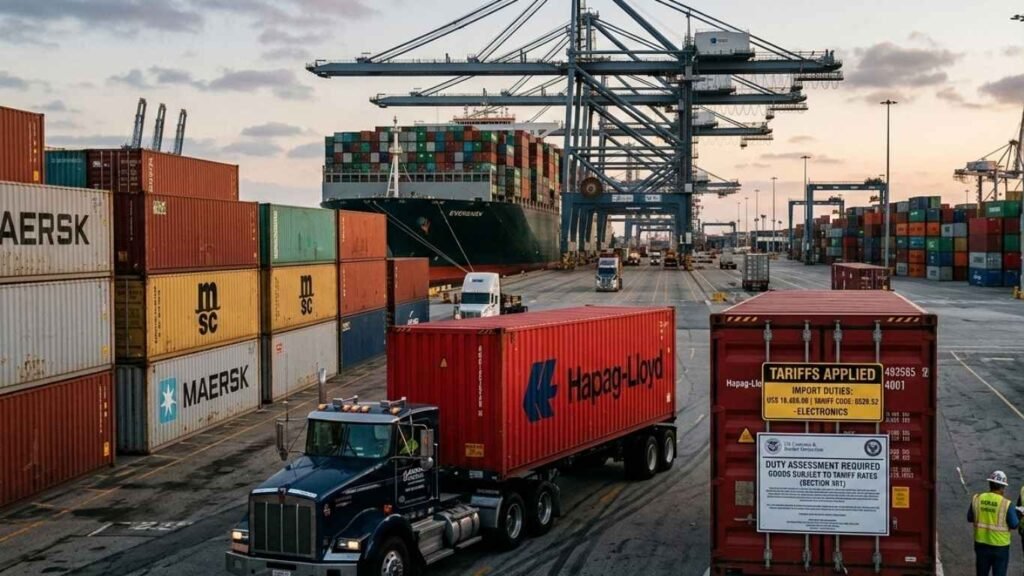
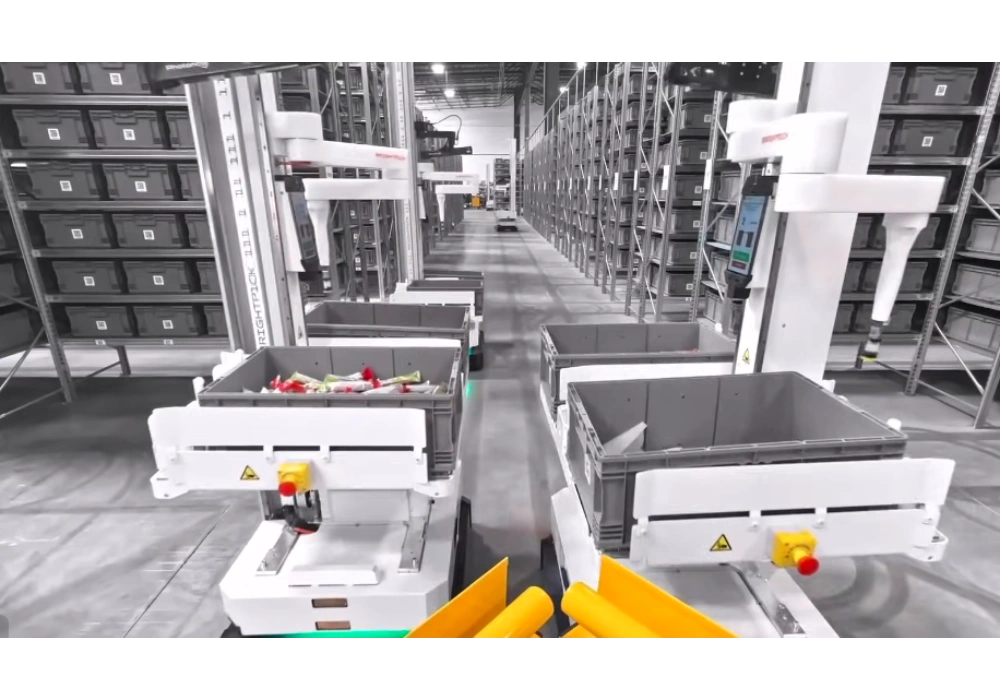
The warehouse automation industry is no longer restricted to just standalone conveyors and barcode scanners. We’re undergoing a digital transformation driven by the infusion of robotics, AI, IoT, and a cloud-based WMS. For example, a review of a U.S. BLS productivity report show that the warehouse and storage industry (NAICS 493) showed a 179.4 for 2024 against a 100 for a base year in 2017.
This means there has been an increase of 79 percent in the number of jobs in the sector over the time of seven years. The combination of job growth with the increase of e-commerce operations has led the managers of warehouses to consider the incorporation of automation as a must-have technology for their operations.
From Mechanical Automation to a Digital Operations Layer
During the initial wave of automation in warehouses, the means were mechanical–conveyors, pallet racking systems, and sortation lines that were stationary. Today, however, automation has evolved because of software.
Management Systems and Execution Systems are ruling over the physical infrastructure and using the software to decode real-time data, manage tasks as well as labor, and reroute inventory instantly.
Labor statistics confirm that the company has been achieving almost the same growth in terms of labor hours as employment growth making it imperative to use management software for control.
Three technology shifts are central to this digital phase:
- Platforms such as cloud-native warehouse management systems (WMS) and warehouse execution systems (WES) that perform inventory management and job allocation in real time instead of during the day.
- Digital models that provide visibility over warehouse processes and layouts before physical changes are made on the warehouse floor in order to avoid costly mistakes.
- Various types of edge computing and IoT sensors to get real-time data on productivity, temperature, and machinery health to allow quicker decision-making.
Workforce Pressure Is a Direct Driver of Automation Spending
One of the clear-cut causes of implementing automation in businesses is caused by employee turnover levels. As of the month, reported from the Bureau of Labor Statistics (BLS) the quit rate in transportation, warehousing and utilities (TWU) in May was a seasonally adjusted rate of 2.6%.
The total number of quit in the TWU sector was approximately 179,000,” the BLS said. “The number of total employments in the warehousing and storage industry (NAICS 493) will total an estimated 1.86 million in 2024.
Given that there are almost 180,000 people quitting their jobs relating to warehousing activities, it is becoming very difficult for companies to keep functioning smoothly.
Automotive Warehousing: A Bellwether for the Wider Sector
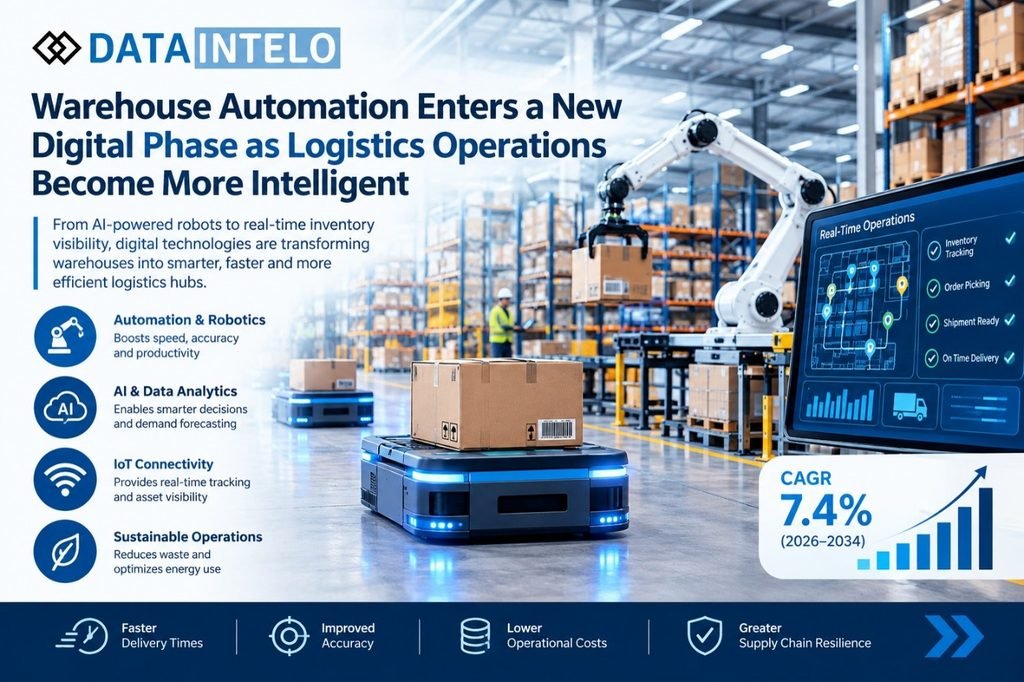
Automotive supply chains illustrate how far this digital shift extends beyond general e-commerce fulfillment. The world automotive warehouse logistics market was worth US$112.4bn in 2025, and expected to reach US$213.8bn by 2034, growing at a compound annual growth rate of 7.4% through 2026 to 2034 forecast period as per DataIntelo’s market research report on automotive warehouse logistics industry.
The warehouse of automotive parts, by its nature of complex SKU – dozens of thousands of unique parts associated with a particular vehicle platform, tended to remain relatively paper-based and highly manual.
Digital inventory tracking, automated sequencing systems, and AI-based demand forecasting are increasingly applied here to reduce part-picking errors and shorten dock-to-line delivery windows for just-in-time manufacturing schedules.
U.S. Warehousing & Storage: BLS Employment and Hours-Worked Index
| Year | Employment Index (2017 = 100) | Hours-Worked Index (2017 = 100) |
| 2019 | 119.4 | — |
| 2020 | 136.6 | 128.8 |
| 2021 | 164.4 | 157.8 |
| 2022 | 184.6 | 175.0 |
| 2023 | 177.8 | 170.0 |
| 2024 | 179.4 | 170.6 |
It appears from the data, work levels and working hours, saw their high points in 2022 and then declined significantly in 2023 & 2024. What seems to appear in the data over this period is organisations, coping with the increase in workload through technology and automation rather than increase their staffing.
Automation performs best on predictable unit loads, so settling the build pattern with a pallet calculator ahead of implementation avoids designing around an inefficient footprint.
E-Commerce Demand Keeps Pressure on Fulfillment Networks
The U.S. e-commerce sales figures for Q4 2025 (seasonally adjusted) were $316.1 billion in online retail sales, according to Census Bureau. That constitutes 16.6 percent of the total retail sales – and continues an ever upward trajectory that has been ongoing for years.
And Total e-commerce sales in 2025 hit $1,233.7 bn which amounted to growth of 5.4% from a year earlier and represented 16.4% of total retail sales as a whole. Each increase in the market share of e-commerce should in turn mean more line items within each order needing to go through the warehouses which helps explain why a digital orchestration system has become just as relevant to your e-commerce store as a physical automaton.
By the Numbers:
- 179.4 — BLS employment index for U.S. warehousing and storage in 2024 (2017 = 100)
- 1.86 million — Workers employed in warehousing and storage (NAICS 493) in 2024, per BLS
- 2.6% — BLS seasonally adjusted quits rate in transportation, warehousing, and utilities (~179,000 workers)
- $316.1 billion — U.S. Census Bureau estimate of Q4 2025 retail e-commerce sales
- 16.6% — Share of total U.S. retail sales made up by e-commerce in Q4 2025, per the Census Bureau
- $213.8 billion — Projected 2034 value of the global automotive warehouse logistics market, according to DataIntelo’s.
Challenges That Still Slow Adoption
Despite the underlying demand signals, integration remains uneven across the industry. Retrofitting legacy warehouses with sensor networks and WES software can take months of downtime planning, and mid-sized operators frequently cite upfront capital cost as a barrier to full automated storage and retrieval builds versus smaller, incremental robotics deployments.
Cybersecurity is a growing concern as more physical equipment connects to cloud dashboards, and workforce reskilling — training staff to supervise and maintain automated systems rather than perform only manual tasks — has become its own line item in automation budgets, particularly as turnover data suggests operators cannot rely on a stable, experienced workforce to manage that transition informally.
Facilities also face a sequencing problem: automation investments made in isolation, without a coordinating software layer, often fail to deliver the productivity gains that justified the spend in the first place. A conveyor or robotic picking cell installed without a WES to schedule its work intelligently can end up idle for large parts of a shift, which is one reason the software layer is increasingly treated as the first purchase rather than an afterthought bolted on once the hardware is already running.
Where This Is Headed
The direction of travel is consistent across every data point cited here: warehouse operations are shifting from mechanical automation toward a digitally orchestrated model where software determines how, when, and where physical automation is deployed.
Warehouse jobs and hours worked climbed 70-80% each since 2017 by BLS figures, e-commerce is continuing its march as a share of total sales by Census figures, and even just the automotive warehouse logistics business segment alone is expected to grow nearly twofold from $112.4 billion to $213.8 billion between today and 2034.
Combined, these suggest that facilities with cloud-native WMS/WES platforms and proactive use of forecasting powered by AI are likely the facilities better equipped to handle a continuing rise in demand without an equivalent increase in human staff or a high level of churn.
AUTHOR BIO:
Ashish Kolte is a Marketing Manager at DataIntelo with expertise in marketing, market intelligence, and business strategy. He combines marketing insights with industry research to help organizations understand market dynamics, identify growth opportunities, and make data-driven decisions. His areas o interest include emerging technologies, artificial intelligence, healthcare, industrial markets, and global business trends. Through his writing, Ashish shares research-backed perspectives on evolving industries and strategic market developments.