
Pallet Calculator
Pallet Calculator
Work out how many cartons fit on a pallet and how many pallets fit in a container. Compares both carton orientations and flags overhang.
Pallet
Carton
Orientation comparison
| Orientation | Per layer | Layers | Total cartons | Area used |
|---|
Container loading
A pallet calculator works out how many cartons fit on a pallet and how many loaded pallets fit in a container. The two variables that decide the answer are carton orientation and whether the limit is height or weight. Getting the orientation wrong typically costs 8 to 15 percent of usable space, and the error repeats on every shipment.
Most loading plans are built once, by someone estimating, and then never revisited. The tool above compares both carton orientations plus a mixed pattern, applies your height and weight limits, and tells you which constraint you actually hit first.
Standard pallet dimensions
| Pallet | Dimensions | Common use | Typical load limit |
|---|---|---|---|
| Standard / ISO | 1200 x 1000 mm | Global shipping, general freight | 1000 to 1500 kg |
| Euro EUR1 | 1200 x 800 mm | European road and rail | 1500 kg dynamic |
| GMA | 48 x 40 in | North American grocery and retail | Around 1134 kg |
| Asia standard | 1100 x 1100 mm | Japan, Korea, parts of Asia | 1000 kg |
The choice is rarely free. Retail customers and destination markets frequently specify the pallet, and shipping a Euro pallet into a network built around GMA sizing creates handling problems at every touch point.
Why orientation matters more than people expect
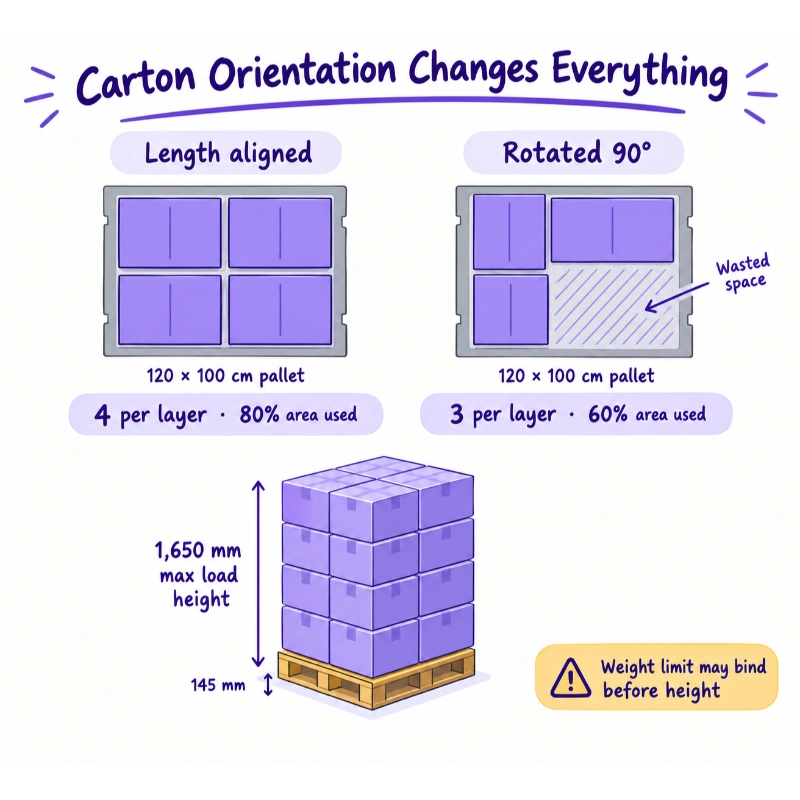
A 600 by 400 mm carton on a 1200 by 1000 mm pallet fits five per layer one way and four the other. That is a twenty percent difference in throughput from a decision nobody consciously made.
The calculator tests both plus a mixed pattern, because irregular carton dimensions frequently fit better when rows are rotated against each other rather than aligned uniformly.
One caveat worth knowing: mixed patterns sometimes produce a higher count but a less stable stack. Where cartons are light and the load travels far, stability usually matters more than the extra unit.
Height limits and what sets them
Load height is constrained by whichever of three limits binds first.
Container or trailer internal height, minus clearance for handling. Customer receiving restrictions, which are often stricter than the equipment allows. And product compression strength, meaning what the bottom carton can carry without deforming.
The third is the one most often assumed rather than tested. Corrugated board loses compression strength significantly in humid conditions, and a stack that holds in a dry warehouse can fail in transit across a tropical route.
Overhang and underhang
Cartons extending beyond the pallet edge lose a disproportionate amount of stacking strength, because the corner posts of the carton below are no longer supported.
Underhang creates a different problem. Cartons set well inside the pallet edge waste footprint and allow the load to shift, and in container loading the wasted space compounds across every pallet in the unit.
The calculator allows a small overhang tolerance because some networks permit it, but as a default, matching the carton footprint to the pallet is worth designing for at the packaging stage rather than accommodating afterwards.
From pallets to containers
Once pallet configuration is set, container loading is largely arithmetic: how many footprints fit on the floor, and how many units high the loaded height permits.
What the arithmetic misses is the practical loss. Dunnage, air bags, door clearance and the simple difficulty of positioning the final pallet mean real loading typically achieves 85 to 90 percent of the theoretical figure.
Volume and chargeable weight interact here too, and the underlying freight economics are covered in reducing transportation cost in logistics.
Designing the carton around the pallet
The highest-return version of this exercise happens before production rather than after.
Specifying a carton whose footprint divides evenly into the pallet removes wasted space permanently. A carton two millimetres too wide, multiplied across a layer, can cost an entire row.
Where packaging is already fixed, the remaining levers are orientation and layer count, which is what the calculator addresses. Where it is not yet fixed, involving logistics in the packaging specification is worth considerably more than any loading optimisation afterwards.
The planning implications of shipment configuration are examined in supply chain planning.
Practical loading discipline
Three habits prevent most loading problems.
Record the agreed pattern and issue it to the packing site as a diagram rather than a description. Verbal instructions produce variation between shifts.
Confirm the loaded height and weight on the first pallet of a new configuration rather than assuming the calculation held. Carton dimensions drift from specification more often than most buyers realise.
And check the receiving customer’s restrictions before finalising, since a pallet built to your optimum that exceeds their maximum height will be rejected or rebuilt at your cost.
Warehouse execution discipline is covered in what a supply chain manager actually does, and supplier packaging compliance sits within managing supply chain risk.
For continuing coverage of loading, freight and distribution practice, see our ongoing logistics operations reporting.
Frequently asked questions
How many cartons fit on a pallet?
It depends on carton footprint, pallet size, maximum load height and weight limit. A 600 by 400 mm carton on a 1200 by 1000 mm pallet fits five per layer, and at a 1650 mm load height with 400 mm cartons that is four layers, giving twenty cartons. The calculator above tests both orientations because the alternative frequently fits more.
How many pallets fit in a 20ft container?
A 20ft container typically takes ten to eleven standard pallets on the floor, or nine to ten Euro pallets, before any double stacking. A 40ft takes roughly twenty to twenty-two. Whether they can be stacked depends on loaded height and on whether the product can bear the weight above it.
What is the maximum pallet height?
It is set by whichever limit binds first: container or trailer internal height minus handling clearance, the receiving customer’s restriction, or the compression strength of the bottom carton. Many networks work to around 1800 mm including the pallet base, but customer restrictions are frequently lower.
Is pallet overhang acceptable?
Some networks tolerate a small overhang of up to around 25 mm, but it reduces stacking strength significantly because the carton below loses corner support. Underhang wastes footprint and allows load movement. Matching carton footprint to pallet dimensions at the packaging design stage avoids both.