
Gravel Calculator
Gravel Calculator
Work out how much gravel an area needs, then how many tonnes, bags and truckloads that becomes for delivery.
Areas to cover
| Shape | Length (ft) | Width (ft) | Depth (in) |
|---|
Material and delivery
Breakdown by area
| Area | Shape | Surface | Volume |
|---|
Delivery planning
Cost estimate
Depth guide
| Application | Recommended depth |
|---|
To work out how much gravel you need, multiply length by width by depth in feet to get cubic feet, divide by 27 for cubic yards, then multiply by about 1.4 to convert to US tons. The gravel calculator above does this automatically and adds the step most tools skip: turning your requirement into truckloads.
Volume is the easy part. What catches people out is that bulk aggregate is sold by weight, delivered by the trip, and settles once compacted. Three separate conversions sit between the tape measure and the invoice, and an error in any one of them means either a second delivery charge or a pile of surplus stone.
How to use this tool
Enter each area you are covering as a separate row. Rectangles need length and width, circles need only a diameter, and triangles need base and height. Irregular sites are best broken into two or three simple shapes rather than averaged into one.
Set the depth for each area independently, because a driveway and a border alongside it rarely want the same depth. Then choose the material, since density varies enough between pea gravel and crusher run to change the tonnage by a quarter.
The compaction field defaults to ten percent. Leave it there unless you have a reason to change it, because loose material delivered to site always occupies more volume than the same stone once raked and rolled.
How much area will a ton of gravel cover?
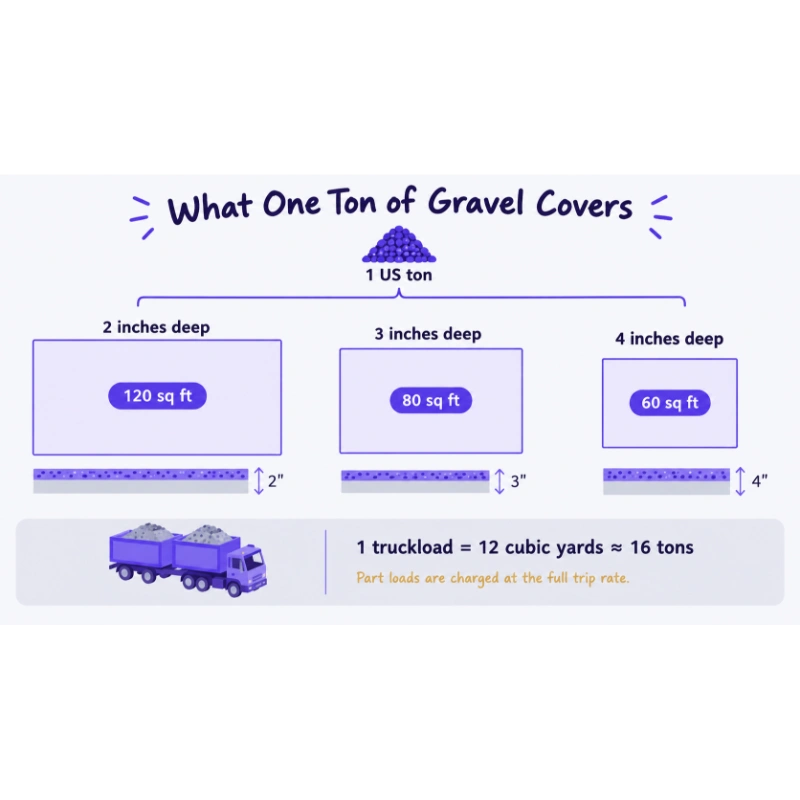
Coverage depends entirely on depth, which is why a single coverage figure quoted without a depth is meaningless.
| Depth | Coverage per US ton | Coverage per cubic yard |
|---|---|---|
| 1 inch | About 240 sq ft | About 324 sq ft |
| 2 inches | About 120 sq ft | About 162 sq ft |
| 3 inches | About 80 sq ft | About 108 sq ft |
| 4 inches | About 60 sq ft | About 81 sq ft |
| 6 inches | About 40 sq ft | About 54 sq ft |
These assume a density around 1.6 tonnes per cubic metre, which covers most decorative and driveway gravels. Heavier materials such as road base cover proportionally less per ton.
Material density and why it changes the answer
A calculator for gravel is only as accurate as the density figure you give it, and quarry material genuinely varies.
| Material | Density | Tons per cubic yard |
|---|---|---|
| Bark mulch | 0.80 t per cu m | 0.67 |
| Topsoil | 1.20 t per cu m | 1.01 |
| Lava rock | 1.35 t per cu m | 1.14 |
| Limestone | 1.52 t per cu m | 1.28 |
| Pea gravel, crushed stone, river rock, sand | 1.60 t per cu m | 1.35 |
| Decomposed granite | 1.80 t per cu m | 1.52 |
| Crusher run and road base | 2.00 t per cu m | 1.69 |
Moisture matters too. Wet aggregate can weigh ten to twenty percent more than the dry figure, which is worth knowing when you are paying by the ton for material that has been sitting in an uncovered stockpile through a wet week.
How deep should the gravel be?
Depth is the single biggest driver of quantity and the variable most often under-specified.
| Application | Depth | Notes |
|---|---|---|
| Decorative beds and borders | 25 to 50 mm, 1 to 2 in | Not load bearing |
| Footpaths and walkways | 40 to 50 mm, 1.5 to 2 in | Over a firm base |
| Driveway surface layer | 50 to 75 mm, 2 to 3 in | Top layer only |
| Driveway total build-up | 100 to 150 mm, 4 to 6 in | Includes compacted sub-base |
| Drainage and French drains | 150 to 300 mm, 6 to 12 in | Void space does the work |
A driveway laid without a compacted sub-base will rut and spread no matter how much decorative stone sits on top. Adding depth to the surface layer is not a substitute for building the layer underneath it.
Truckloads, tipping access and minimum charges
The calculator gravel suppliers use internally works the same way as the one above, with one addition: they price by the trip rather than by the ton of capacity used.
That produces a cost step rather than a smooth curve. Ordering thirteen cubic yards when the vehicle carries twelve means paying for two deliveries, and the second one arrives almost empty.
| Vehicle | Capacity | Access needed |
|---|---|---|
| Pickup truck | About 1 cu yd | Any driveway |
| Single axle tipper | About 5 cu yd | Standard residential |
| Tandem tipper | 10 to 14 cu yd | Firm surface, turning room |
| Tri-axle tipper | 16 to 18 cu yd | Good access, tipping clearance |
| Articulated tipper | 22 to 25 cu yd | Commercial access |
Tipping needs vertical clearance far above the vehicle height, and that is the constraint people forget. Overhead cables, low branches and carport roofs all prevent a body being raised, and a truck that cannot tip either gets unloaded by hand or leaves still loaded.
Four mistakes that cause a second order
Ignoring compaction. This gravel estimate calculator adds ten percent by default because finished depth and delivered volume are not the same thing.
Using a generic density. Confirm the figure with your supplier when the order is large, since you are paying by weight and a quarter-tonne error at scale is expensive.
Measuring the wrong depth. The number that matters is finished compacted depth, not the depth of loose stone you tip out.
Rounding down. Surplus aggregate is usable or easily disposed of. Running short means a second minimum-charge delivery for a fraction of a load, which frequently costs more than the material itself.
Getting the order right first time
Before booking, run the gravel calculator once with your intended depth and once with the depth a quarter-inch greater. If the second figure still fits within a single vehicle load, order it. The extra material costs very little and removes the risk of a second delivery entirely.
Confirm where the load will be tipped and whether the ground will carry a loaded vehicle in current conditions. A tipper sinking into soft ground is an expensive afternoon and sometimes a repair bill.
For larger projects the same load-planning logic that governs palletised freight applies here: minimising the number of trips matters more than optimising any individual load, because transport dominates the delivered cost of every bulk material. The underlying economics are examined in reducing transportation cost in logistics.
Where aggregate forms part of a wider construction programme, scheduling and procurement considerations are covered in supply chain planning, and long-lead material exposure in managing supply chain risk.
The gravel calculator above is built around delivered cost rather than volume alone, which is why it reports trips and final-load size alongside tonnage. For continuing coverage of bulk haulage and construction freight markets, see our ongoing logistics and freight reporting.
Frequently asked questions
How do I calculate how much gravel I need?
Multiply length by width by depth, with all three in feet, to get cubic feet. Divide that by 27 for cubic yards, then multiply by roughly 1.4 to get US tons. Add five to ten percent for compaction before ordering.
How much will 1 ton of gravel cover?
About 120 square feet at 2 inches deep, 80 square feet at 3 inches, or 60 square feet at 4 inches. Coverage halves as depth doubles, so a coverage figure quoted without a depth tells you nothing useful.
How much gravel do I need for a 10×10?
A 10 by 10 foot area is 100 square feet. At 4 inches deep that is about 1.2 cubic yards, or roughly 1.7 US tons. Allow closer to 1.9 tons once a ten percent compaction margin is included.
How many 50lb bags of gravel are in a yard?
About 54 bags, since a cubic yard of typical gravel weighs around 2,700 pounds. At that count, bulk delivery is almost always cheaper unless you need less than a single cubic yard.