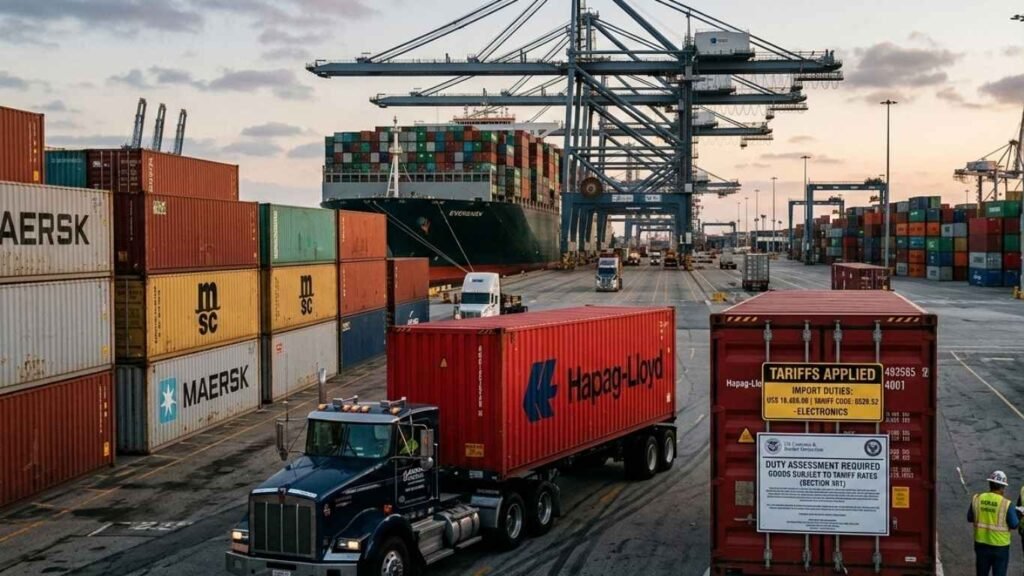

Logistics plans and executes the physical movement and storage of goods: transportation, warehousing, order fulfilment and last-mile delivery. Supply chain management includes logistics plus demand planning, supplier strategy, network design, inventory policy and S&OP. Every logistics decision is a supply chain decision. The reverse is not true.
A distribution centre in Memphis serving a customer base that has shifted to the Northeast costs money in freight every single day until the network is redesigned. Ask the VP of Logistics to evaluate adding a New Jersey site and they will optimise for logistics variables: outbound rates, warehouse operating cost, carrier service.
What they may not model is inventory carrying cost across the whole network, the demand planning implications, the supplier lead time structure that determines where safety stock must sit, or the capital case. That is a supply chain design decision being made with logistics tools.
The scope difference
| Logistics covers | Supply chain adds |
|---|---|
| Transportation management | Supplier selection and sourcing strategy |
| Warehousing operations | Demand forecasting and planning |
| Order fulfilment execution | Distribution network design |
| Last-mile delivery | Inventory policy and positioning |
| Reverse logistics | S&OP and SIOP coordination |
| Make versus buy decisions |
The metrics tell you which discipline you are measuring
| Logistics metrics (execution) | Supply chain metrics (design) |
|---|---|
| On-time delivery rate | Total supply chain cost as % of revenue |
| Transportation cost per unit | Inventory turns |
| Warehouse cost per order | Forecast accuracy |
| Carrier utilisation | Perfect order rate |
| Order accuracy | Days of supply |
| Damage rate | Disruption recovery time |
A company can post excellent logistics metrics and poor supply chain performance. Efficient shipping from the wrong location is still shipping from the wrong location.
Why the distinction affects hiring
The professional bodies maintain separate credentials precisely because the knowledge bases differ. Supply chain credentials cover network design, demand planning and S&OP. Logistics credentials cover carrier management, warehouse operations and distribution execution.
Both are valuable. They are not interchangeable, and a role needing one will not be well served by the other. The scope question also shapes what a supply chain manager is accountable for versus what logistics leadership roles cover day to day.
Network and planning decisions are examined further in our guide to supply chain planning, while execution cost levers are covered in reducing transportation cost in logistics.
Where the confusion costs real money
Two organisational errors follow directly from treating the terms as interchangeable.
The first is delegating design decisions to execution managers. Asking a logistics leader whether to add a distribution centre puts a structural, multi-year financial decision in the hands of someone whose tools and incentives are built around freight rates and warehouse productivity. They will answer the question they can measure, which is not the question that was asked.
The second is measuring strategy with execution metrics. When leadership reviews supply chain performance through on-time delivery, cost per order and carrier utilisation, structural problems stay invisible. The network can be wrong for years while every operational indicator looks healthy, because the metrics were designed to assess execution within the network rather than the network itself.
The fix in both cases is the same. Be explicit about which category of decision is being made, and make sure the person deciding has both the analytical tools and the accountability horizon that decision requires.
Frequently asked questions
Is supply chain the same as logistics?
No. Logistics is a component within supply chain management, covering physical movement and storage. Supply chain management is the broader discipline that also includes supplier strategy, demand planning, network design, inventory policy and cross-functional planning. All logistics activity is supply chain activity, but much supply chain work is not logistics.
What decisions does supply chain make that logistics does not?
Where distribution centres should be and how many, how much inventory to hold and where to position it, how to allocate constrained supply across customers, and whether to produce to forecast or to order. Logistics optimises execution within the structure those decisions create.
Can good logistics metrics hide poor supply chain performance?
Yes, and this is the most common measurement failure. Trailer utilisation, cost per order and on-time delivery can all look strong while the network itself is wrong for the customer base, meaning a structural freight premium is paid on every shipment and never appears as a variance.
Which certification covers supply chain versus logistics?
Supply chain credentials focus on end-to-end strategy, network design, demand planning and S&OP. Logistics credentials focus on transportation modes, warehouse operations, carrier management and distribution execution. Procurement has its own separate credential track covering sourcing and supplier management.